
When recovering from cancer means reshaping your identity
February 20, 2026
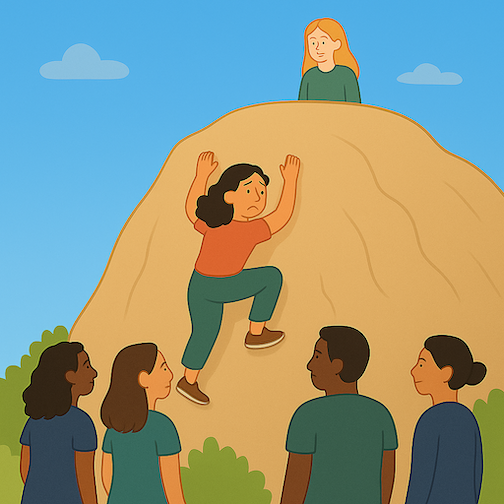
Me, in my dream, stuck.
“It takes a lot of courage to let go of who we think we are.” Mary Dwyer
In late 2023, I was diagnosed with lung cancer. After surgery, thankfully, so far, I’m cancer-free. I previously wrote about my experience with diagnosis and surgery and about the humility and release of control I learned during recovery. The topic this time is rethinking my self-image.
. . . . .
A few months into cancer recovery I had a dream. I was having dinner at an outdoor restaurant on a landing with my massage therapist Madeline. She said “let’s go to the lower level.” From the top it looked like getting to the lower level meant walking down a path. But once I’d started to go down, I got stuck on a sheer cliff, in a rock climbing position with one leg bent, the other straight, and both hands on the only rocks that were sticking out from the wall. I couldn’t figure out how to move down or get back up where I was. Madeline was standing on the top looking down at me with a gentle and supportive gaze. I was totally stuck.
Stuck is not something I was used to feeling. My path through life has taken me through many passions and multiple careers, and I usually don’t stay stuck for long. But this was different. I was in brand new territory. Recovering from a serious illness was not in my experience. Sure, I’d accompanied plenty of other people on their paths to recovery, but I was the one doing the taking care of, visiting the patient, not the one that needed to find my footing again.
Recovery forced me to re-evaluate who I am, to shift the way I think about myself.
Ah, the mindset shift
A therapist reminded me: the mindset shift is as much a part of recovery as the physical aspect.
In my 30s and 40s, I felt like the fit girl in the fast car—working out, teaching yoga across Los Angeles, hiking, and driving a pretty blue sedan that could go fast. I still sometimes see myself as the fit girl in the fast car, a persona that’s long gone. It’s not just me, ask anyone in their 50s or beyond and they’ll tell you they still feel like their younger selves. I just hadn’t realized I was doing that too.
In mid-2023, I moved to a new city, and went to check out fitness classes at the gym. The Body Pump class was populated with a group of fit middle-aged and senior women lifting weights and doing HIIT exercises. I immediately thought "these are my people." Soon after, I was diagnosed with lung cancer. More than two years later, not only have I never been to that class, I can't imagine lifting that much weight. My new self is working with weights 5 lbs and under. Will I ever make it to that class? I’m not sure, but I’m not counting on it.
Another part of the mindset shift has been my perception of myself as a body-aware person. I’ve spent most of my adult life moving in one way or another. I studied many types of dance in my 20s, and have just celebrated 35 years of yoga practice. One of my strongest areas of competency has been my own body awareness and ability to figure out what’s happening when medical professionals have no clue, and how to manage decades of random musculoskeletal injuries. Backache, no problem, I can fix that, just need some ice and physical therapy exercises. Whatever, it’s fixable.
My first experience with something not-fixable was in 2021 when I was diagnosed with arthritis in my left thumb. I went to occupational therapy and in all sincerity told the therapist “I’ve had tons of physical therapy, if you just tell me what to do I’ll follow your instructions and this will be fixed.” She looked a little surprised and said “this can’t be fixed, it’s a degenerative condition. You’ll need to learn how to live with it.” It was the first time someone had told me I had a chronic condition that I couldn’t “fix” with a pill, and it proved to be the first baby step towards having to learn to accept things I can’t change in my body.
Cut back to late 2023. I had lung cancer and didn’t know it. My body gave me no signals, no clues I could sense or interpret. Now, when an ache or pain arises, I feel unmoored—uncertain whether it’s something I need to heed or just a distraction passing through.
This passage from Suleika Jaouad’s brilliant book Between Two Kingdoms, where a college athlete shared her cancer experience with Suleika, describes how I was feeling:
Before, if you had asked me who I was, I would have identified as an athlete. But now, I’m not so sure, because cancer does a weird thing to you. It takes who you are and what you think you know and throws that all in the trash. [page 233]
At some point I started asking: What’s my new normal? I wanted someone to tell me what I should expect, how much capability could be recovered. I wanted to know how much loss of capability to mourn.
It turns out movement training has a helpful framework for this too. In choreography there’s a structure called ABA. The first movement in the choreography is A, the next movement is B, then you repeat A. But after you do B, you’re not the same even if you repeat A. You can never repeat A precisely the same way, which of course is the beauty of dance, what makes it interesting and not robotic. It’s also life. We don’t “go back to” some older version of ourselves after a serious illness.
Another passage from Between Two Kingdoms:
As we live longer and longer, the vast majority of us will travel back and forth across these realms [of the sick and well] spending much of our lives somewhere in between. These are the terms of our existence. The idea of striving for some beautiful, perfect state of wellness? It mires us in eternal dissatisfaction, a goal forever out of reach. [page 274]
I’ve learned that imperfect is the new normal. It’s about living with more grace, not living in a perfectly healthy body.
Acceptance
I had to find a way to accept my new normal, my new self-identity. It’s helped that at some point I realized what I’d been characterizing as cancer recovery was really just plain old aging.
In Patanjali’s Yoga Sutra [2.9] it says that “even among the wise, the desire for continuity is strong.“ Meaning, even when we overcome craving, aversion, and other human pulls, the will to live is hard to let go of, and the recognition of death is challenging. It’s not just about the Big D death, but all the “little d” deaths along the way, like death to my image of myself as the fit girl in the fast car. Or my assumption that I’d be one of those Blue Zone people, walking up and down hills at 100, defying the odds, living longer and better than imaginable. I’ve known several centenarians, I have a cousin who is 102 as we speak, and she’s lived a very full life but she never had cancer or another serious illness, so I don’t feel like I’m in her league.
Decades ago when I was in yoga teacher training, we were shown videos of master yogi T. Krishnamacharya at 50 doing the Ashtanga primary series (a very athletic form of yoga), and at 94 after a hip fracture, on his bed using a pulley to lift and lower himself, getting himself back to mobility. He lived to 100. At the time, I was in my 30s (the fit girl in the fast car) and those videos struck me hard. Seeing his mastery at accepting his abilities and limitations, and practicing appropriately based on his current condition, has been an inspiration for decades.
I’m in a weekly meditation group with about a dozen people, and half are octogenarians. We meditate together, then discuss topics related to our practice and life. My cohorts are wise souls and I look forward to their regular insights on aging and acceptance. With or without cancer, I’d still be aging, and learning the lessons that accompany that process. My octogenarian friends are helping me realize that there’s no going back to the past, and what it can look like to grow into the kind of older person I want to be.
Another learning: Wise people accept that everything is impermanent.
Embrace?
Two years after surgery, I’m finally coming around to my new identity, starting to embrace a new me. It’s a work-in-progress.
To be clear, embracing a me that is not the fit girl in the fast car is not the same as giving up. It’s taking a realistic approach to life in this stage of my existence.
I’ve been doing an acceptance and gratitude practice for a couple of years. With the inhale, I silently recite Acceptance. With the exhale, Gratitude. The gratitude part is going really well. It’s easy to find things I’m grateful for. The acceptance part has been the challenge, but I’m slowly getting there. I’ve started to move past acceptance to embrace. Acceptance feels like it’s relative to an old reality (I must accept the old reality is no longer true), where embrace is more about cultivating a future me.
There’s still plenty of growth in my life, but it looks different. It’s not the same kind of growth you experience when young, it’s more internal, so I can feel it rather than see external progress. You’re not going to see me building big muscles, but I’m getting stronger at the core.
I’m enjoying slowing down. I’m releasing my identity of accomplishment, and taking time to rest. The pandemic had already made me more selective about what I want to do with my time and who I want to spend it with -- now I’m REALLY selective. I say no to way more things.
I don’t have big ambitions and I’m totally comfortable with that.
I recently married the man I've been with for nearly 10 years. Why now? It just seemed right. We wanted to deepen this relationship further.
I recently retired from the tech industry and have returned to my love of teaching yoga.
I’m experiencing a more simple and qualitatively richer way of life, and envisioning more of that in my future.
. . . . .
Thanks so much to Kimra McPherson for her incredible thought partnership in shaping not only this story but the entire series.